
Why UK Businesses Still Need Online Directories in 2026
Directories don't just get you found — they quietly vouch for your business to Google and customers alike. Here's why UK companies still can't afford to ignore them, and how to actually get it right
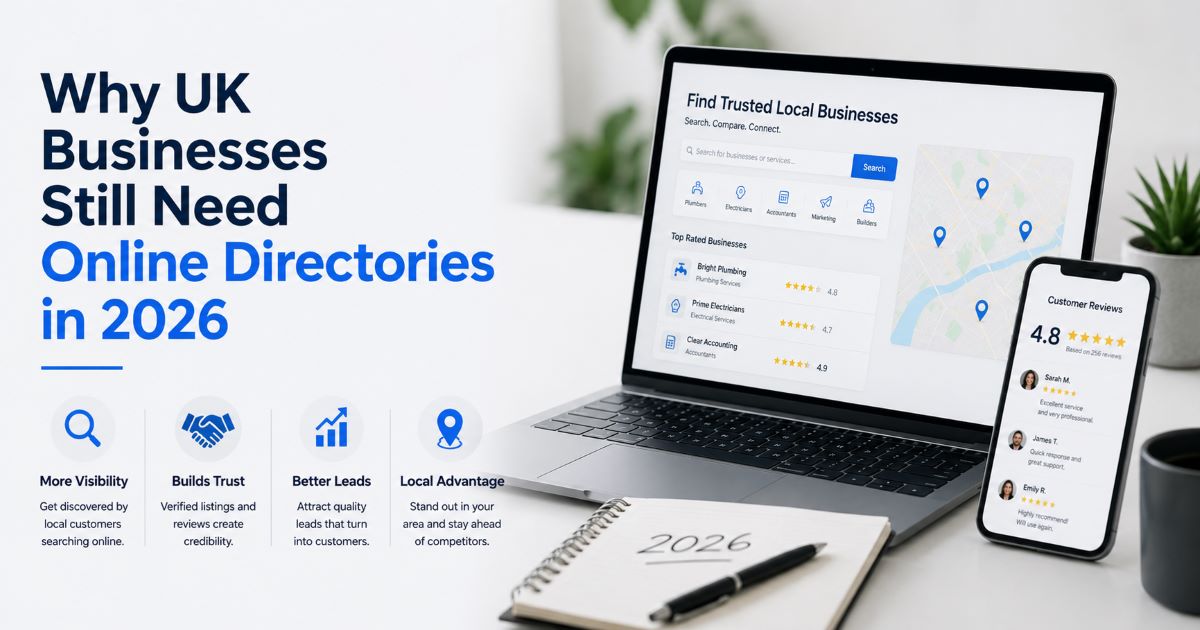
Why UK Businesses Still Need Online Directories in 2026
A website alone won't cut it anymore. If you're running a business in the UK and your only online presence is your own site, you're leaving traffic — and trust — on the table.
Business directories get dismissed a lot these days. People assume they're a relic from the early 2000s, back when Yellow Pages went digital and everyone rushed to claim a listing. But that's not quite right. Directories like Yell, Thomson Local, FreeIndex, and Google Business Profile still send real traffic, and they still matter to how search engines judge your credibility.
Here's why that's the case, and how to actually get value out of them.
They're Not Just About Being "Findable"
The obvious pitch is visibility — more places online where someone can stumble across your business. That's true, but it undersells what directories actually do.
Search engines like Google cross-check your business name, address, and phone number (often called NAP data) across the web. If your listing on Yell says one address and your website says another, that inconsistency quietly damages your local search rankings. Directories are, in a sense, a trust exercise with Google as much as with customers.
There's also the backlink angle. A listing on a reputable, high-authority directory is a legitimate backlink to your site — not the spammy kind Google penalises, but the kind that signals your business is real and active.
The Trust Factor Is Underrated
Think about how you personally vet an unfamiliar business. You probably check if they show up on Google Maps, whether they have reviews, and whether their contact details look legitimate. That's essentially what a directory listing does at scale — it gives strangers a reason to believe you're not a shell operation.
A profile with a proper description, real photos, and a handful of honest reviews does more for conversion than most businesses give it credit for.
Getting Listings Right (Most Businesses Get This Wrong)
The mistake isn't skipping directories — it's setting up a listing once and forgetting about it. A few things worth getting right:
Use the exact same business name, address, and phone number everywhere. No abbreviations on one site and full names on another.
Write a description that actually says something specific about what you do, rather than generic filler.
Pick the most accurate category — don't stretch into adjacent categories hoping for more reach.
Add real photos, not stock images.
Ask happy customers for reviews, and actually reply to the ones you get, good or bad.
Revisit listings when anything changes — new hours, new address, new phone number.
Duplicate listings are a quieter problem worth checking for. If your business got listed twice by accident (common after a rebrand or house move), it splits your reviews and confuses both customers and search engines.
Which Directories Are Worth Your Time
Not every directory is equal, and chasing quantity over quality wastes effort. Prioritise ones with:
Genuine domain authority (check if they rank well themselves)
A UK-specific audience, not a global directory where you're buried among thousands of unrelated listings
Categories relevant to your actual industry
Review functionality that people actually use
Google Business Profile should be non-negotiable — it's free and it's the first thing that shows up for local searches. Beyond that, industry-specific directories (a trades directory if you're a builder, a legal directory if you're a solicitor) tend to outperform generic ones for lead quality.
The Bottom Line
Directories aren't a silver bullet, and they won't fix a weak website or a mediocre product. But they're a low-effort, high-return piece of a local SEO strategy that a lot of UK businesses either ignore or half-do.
If you haven't audited your listings in the last year, that's probably worth an afternoon. Check for inconsistencies, claim any unclaimed profiles, and make sure the version of your business that Google sees matches the one your customers actually walk into.
Frequently Asked Questions
Share this post
Comments (0)
No comments yet. Be the first to comment!