
The Complete Guide to Local Business Listings in the UK
Discover how to set up, optimise, and manage local business listings across Google, Bing, and top UK directories — and turn local search into more customers.
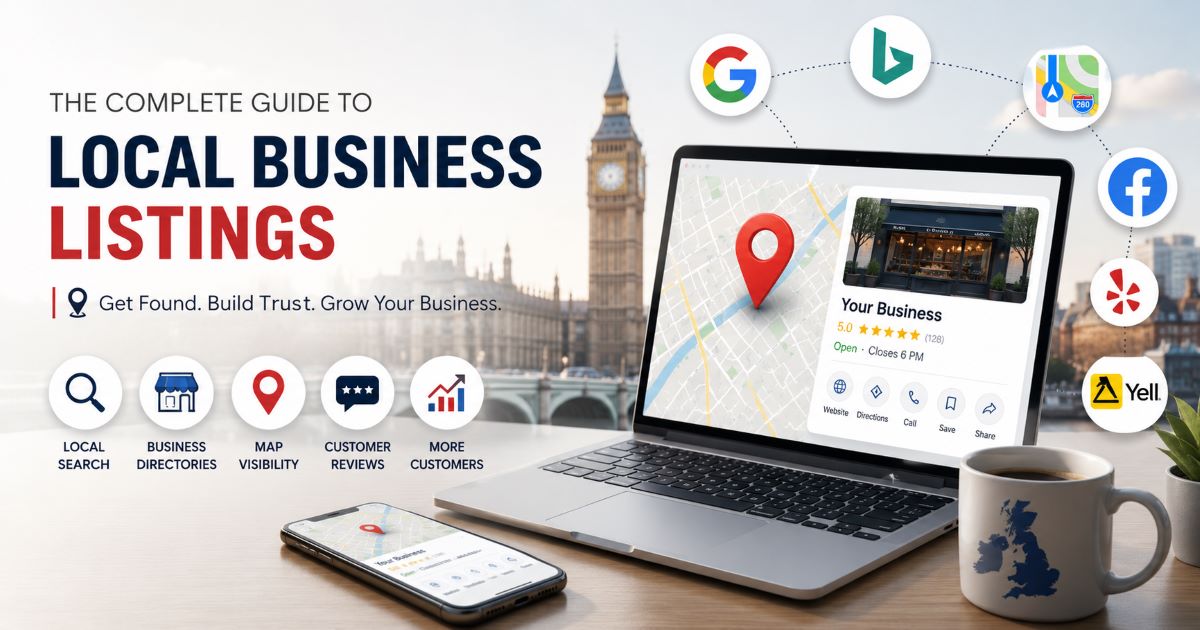
If you run a business in the UK and want more customers to find you — whether they're searching on Google, using Apple Maps, or asking a voice assistant for "plumbers near me" — local business listings are one of the highest-value, lowest-cost marketing tools available. This guide walks through what listings are, why they matter, and how to build and manage them properly.
What Is a Local Business Listing?
A local business listing is an online profile that contains your core business information: name, address, phone number (often shortened to "NAP"), website, opening hours, categories, and photos. These listings appear on:
-
Search engines (Google Business Profile, Bing Places)
-
Map apps (Google Maps, Apple Maps, Waze)
-
Directories (Yell, Thomson Local, Yelp, Trustpilot)
-
Social platforms (Facebook, Instagram)
-
Niche and industry-specific directories (Checkatrade, TripAdvisor, OpenTable)
-
Voice assistants and AI search tools, which increasingly pull from these same sources
Think of listings as digital signposts. The more accurate, consistent, and complete they are, the easier it is for both search engines and customers to trust and find you.
Quick summary: To get found locally in the UK, claim your Google Business Profile, keep your name/address/phone number identical across every directory, fill out every field, add fresh photos, and actively collect reviews. This one habit does more for local visibility than almost any other marketing task.
Why Local Listings Matter
1. Visibility in local search A large share of searches carry local intent — someone typing "bakery near me" wants a result within walking or driving distance, right now. Listings are what make that possible.
2. Trust and credibility A business with consistent, detailed listings across multiple platforms signals legitimacy. Gaps, outdated hours, or missing photos can quietly cost you customers before they ever contact you.
3. Free advertising Most core listings (Google Business Profile, Bing Places, Facebook) cost nothing to create and maintain. Few marketing channels offer this kind of return for the time invested.
4. Better map and voice search rankings Search engines rank businesses partly on the completeness and consistency of listing data. A well-optimised profile improves your odds of appearing in the coveted "map pack" — the top three local results shown above organic listings.
5. Reviews and reputation Listings are usually where customers leave reviews. Reviews influence both rankings and the decisions of prospective customers reading them.
The Key Elements of a Strong Listing
-
Business name — exactly as it appears on your signage and website, no keyword-stuffing
-
Address — a real, consistent format matching your other listings and official records
-
Phone number — ideally a local number, not just a mobile or call centre line
-
Website URL — linking to the most relevant page, not always just your homepage
-
Categories — chosen carefully; the primary category has outsized influence on which searches you appear in
-
Hours of operation — including holiday and seasonal changes
-
Photos — exterior, interior, team, and product/service shots build trust. SEO tip: name image files descriptively (e.g.,
bakery-shopfront-london.jpg) and add alt text like "Fresh bread display at [Business Name] bakery in London" — this helps image search and accessibility. -
Description — a clear, honest summary of what you do and who you serve
-
Reviews — actively requested and responded to
Step-by-Step: Setting Up Your Listings
1. Claim and verify your Google Business Profile
This is the single most important listing for most UK businesses. Search for your business on Google; if a profile already exists, claim it. If not, create one. Verification is usually done by postcard, phone, or email, depending on your business type.
2. Set up Bing Places and Apple Business Connect
Smaller in market share than Google, but low effort to set up and worth the incremental visibility, particularly for Apple Maps and Microsoft/Edge users.
3. Choose the right core directories
For general UK visibility: Yell, Thomson Local, Cylex, and Scoot. For trades: Checkatrade or Rated People. For hospitality: TripAdvisor and OpenTable. For B2B: Companies House-linked directories and industry associations often carry weight too.
4. Ensure NAP consistency everywhere
Search engines cross-reference your name, address, and phone number across the web. Inconsistencies — "St." vs "Street," an old phone number still floating around on an old directory — can dilute your local ranking signals. Audit existing listings before creating new ones.
5. Fill out every available field
Empty fields are missed opportunities. Categories, attributes (wheelchair accessible, outdoor seating, free Wi-Fi), service areas, and payment methods all help match you to more specific searches.
6. Add photos regularly
Listings with photos receive significantly more engagement than those without. Update seasonally or whenever your premises, menu, or offering changes.
7. Build a review pipeline
Ask satisfied customers directly — in person, via receipt, or by email/SMS follow-up. Respond to every review, positive or negative, professionally and promptly. A thoughtful reply to a negative review often does more for your reputation than the review itself does damage.
Common Mistakes to Avoid
-
Duplicate listings — multiple profiles for the same location confuse search engines and dilute your ranking signals. Search thoroughly before creating a new listing.
-
Inconsistent information — a mismatched address or phone number across platforms is one of the most common causes of poor local rankings.
-
Ignoring reviews — unanswered reviews, especially negative ones, suggest a business that isn't paying attention.
-
Using a virtual office or PO box where a real address is required — this can get listings suspended.
-
Keyword-stuffing the business name (e.g., "Smith Plumbing — Best Emergency Plumber London") — this violates most platforms' guidelines and can lead to removal.
-
Setting and forgetting — hours change, phone numbers change, services expand. Listings need periodic review, not just a one-time setup.
Maintaining Your Listings Over Time
Local listings aren't a "set it and forget it" task. Build a simple routine:
-
Monthly: check for and respond to new reviews; post any updates or offers on Google Business Profile
-
Quarterly: audit NAP consistency across your top 5–10 listings; refresh photos
-
Annually: review categories, description, and service areas as your business evolves
Final Thoughts
Local business listings are a foundational piece of any UK business's online presence — arguably more important for local trade and service businesses than a polished website. The businesses that win the most local visibility aren't necessarily the biggest; they're the ones with complete, accurate, consistently maintained listings and a steady stream of genuine reviews.
Start with Google Business Profile, get your NAP consistent everywhere, and build outward from there. Small, regular maintenance beats a one-off setup every time.
Frequently Asked Questions
Share this post
Comments (0)
No comments yet. Be the first to comment!